TDEE for Sustainable Weight Gain: How to Use Your TDEE to Gain Weight
✍️ Written by: Dr. Michael Chen, PhD in Nutritional Sciences
🩺 Medically Reviewed by: Dr. Sarah Jenkins, MD, Board Certified Endocrinologist
📅 Last Updated: September 2026
Gaining weight in a healthy, controlled manner requires understanding your total energy needs. Whether your goal is to build lean muscle, recover from an under-eating period, or overcome a high metabolism, using your Total Daily Energy Expenditure (TDEE) to guide your calorie surplus is the most reliable strategy.
Without knowing your maintenance calories, attempting to gain weight often leads to either frustrating lack of progress or excessive fat gain. In this guide, we break down how to calculate your TDEE for weight gain, determine the ideal calorie surplus, balance your macronutrients, and track your progress effectively.
Calculate Your Maintenance & Surplus Calories
Get personalized daily calorie and macro recommendations tailored specifically for sustainable weight gain.
What Is TDEE and Why Is It Essential for Weight Gain?
Your Total Daily Energy Expenditure (TDEE) is an estimate of the total number of calories your body burns in a 24-hour period. It accounts for your baseline metabolic function as well as all daily movement and exercise.
To gain weight, you must consume more energy than your body expends—a state known as a calorie surplus. Your TDEE serves as the baseline maintenance line. Eating above this baseline ensures your body has the extra energy and building blocks necessary to synthesize new muscle tissue and gain weight.
The 4 Components of TDEE
Basal Metabolic Rate (BMR): The calories burned carrying out basic life-sustaining functions at rest (typically 60–70% of TDEE).
Thermic Effect of Food (TEF): Energy consumed digesting, absorbing, and processing nutrients (roughly 10% of total intake).
Exercise Activity Thermogenesis (EAT): Calories burned during structured workouts like resistance training or cardio.
Non-Exercise Activity Thermogenesis (NEAT): Calories burned through unstructured movement like walking, fidgeting, and posture maintenance.
Understanding NEAT is especially critical for weight gain, as some individuals naturally increase subconscious movement when calories rise, requiring slightly higher surplus targets over time.
How to Calculate Your Calorie Surplus for Weight Gain
To calculate your weight gain calorie target, follow a simple three-step process:
With a consistent surplus of 300–500 calories above TDEE, noticeable weight changes usually appear on the scale within 2 to 3 weeks.
What if I am not gaining weight despite eating above my TDEE?
If your scale weight remains flat over 14 days, your actual TDEE may be higher than estimated due to increased NEAT. Increase daily intake by an additional 200 calories and reassess.
Should I do cardio while trying to gain weight?
Yes. Moderate cardiovascular exercise supports heart health and recovery without consuming excessive energy. Simply account for cardio activity in your total TDEE calculation.
Scientific Evidence & References
This article relies on peer-reviewed energy balance literature and exercise science studies indexed by PubMed and NCBI.
Slater GJ, et al. Is an Energy Surplus Required to Maximize Skeletal Muscle Hypertrophy in Resistance-Trained Individuals? Front Nutr. 2019. (NCBI [1])
Morton RW, et al. A systematic review, meta-analysis and meta-regression of the effect of protein supplementation on resistance training-induced gains in muscle mass and strength in healthy adults. Br J Sports Med. 2018. (PubMed [2])
A Word From Our Team
Healthy weight gain is a gradual, deliberate process that requires consistent energy surplus, adequate protein intake, and progressive resistance training. Our calculator suite uses validated clinical formulas to help you estimate your baseline needs and establish an effective weight gain plan.
Important: This guide is for general educational purposes only and does not constitute medical advice.
Calculate your Total Daily Energy Expenditure (TDEE) and estimate how many calories you burn each day based on your body information and activity level.
⚙️ TDEE Calculator
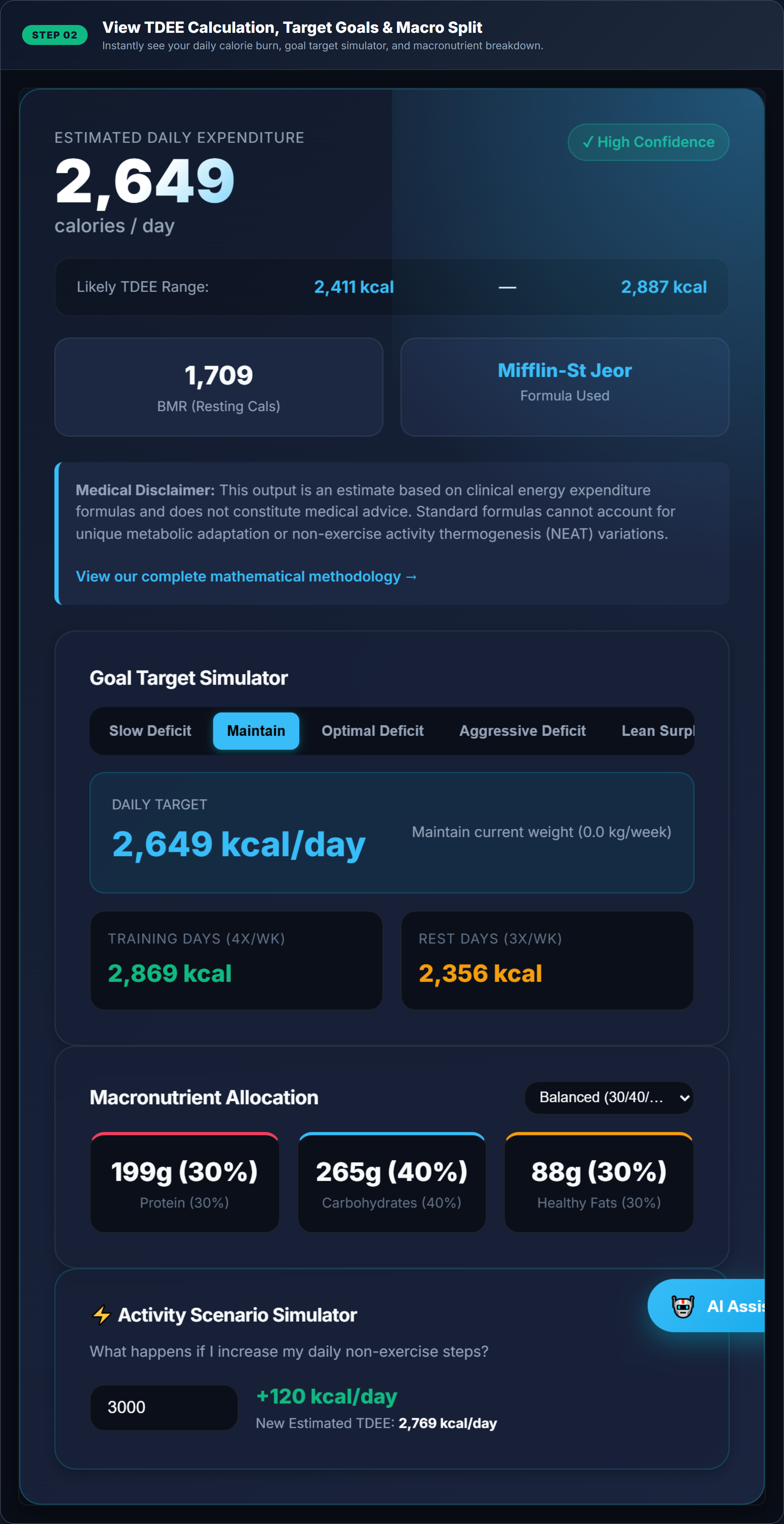
Estimated
Daily Expenditure
2,450
calories / day
✓ High Confidence
Likely TDEE Range:2,230 kcal — 2,670 kcal
1,720
BMR (Resting Cals)
Mifflin-St Jeor
Formula Used
Medical Disclaimer: This output is an estimate based on clinical energy expenditure formulas and does not constitute medical advice. Standard formulas cannot account for unique metabolic adaptation or non-exercise activity thermogenesis (NEAT) variations.
What happens if I increase my daily non-exercise steps?
+120 kcal/day
New Estimated TDEE: 2,570 kcal/day
Unsure Which Activity Level You Are?
Take our 60-second Movement Questionnaire to calculate your custom
multiplier.
Step 1: What is your average daily step count?
Under 5,000 steps
Mostly sitting, desk job, minimal walking.
5,000 – 8,000 steps
Light daily walking, typical office worker.
8,000 – 12,000 steps
Active lifestyle, regular walks & movement.
12,000+ steps
Standing job, waiter, nurse, tradesperson.
Calculated Activity Factor: 1.48
Matches Moderately Active baseline
🔬 Signature Differentiator
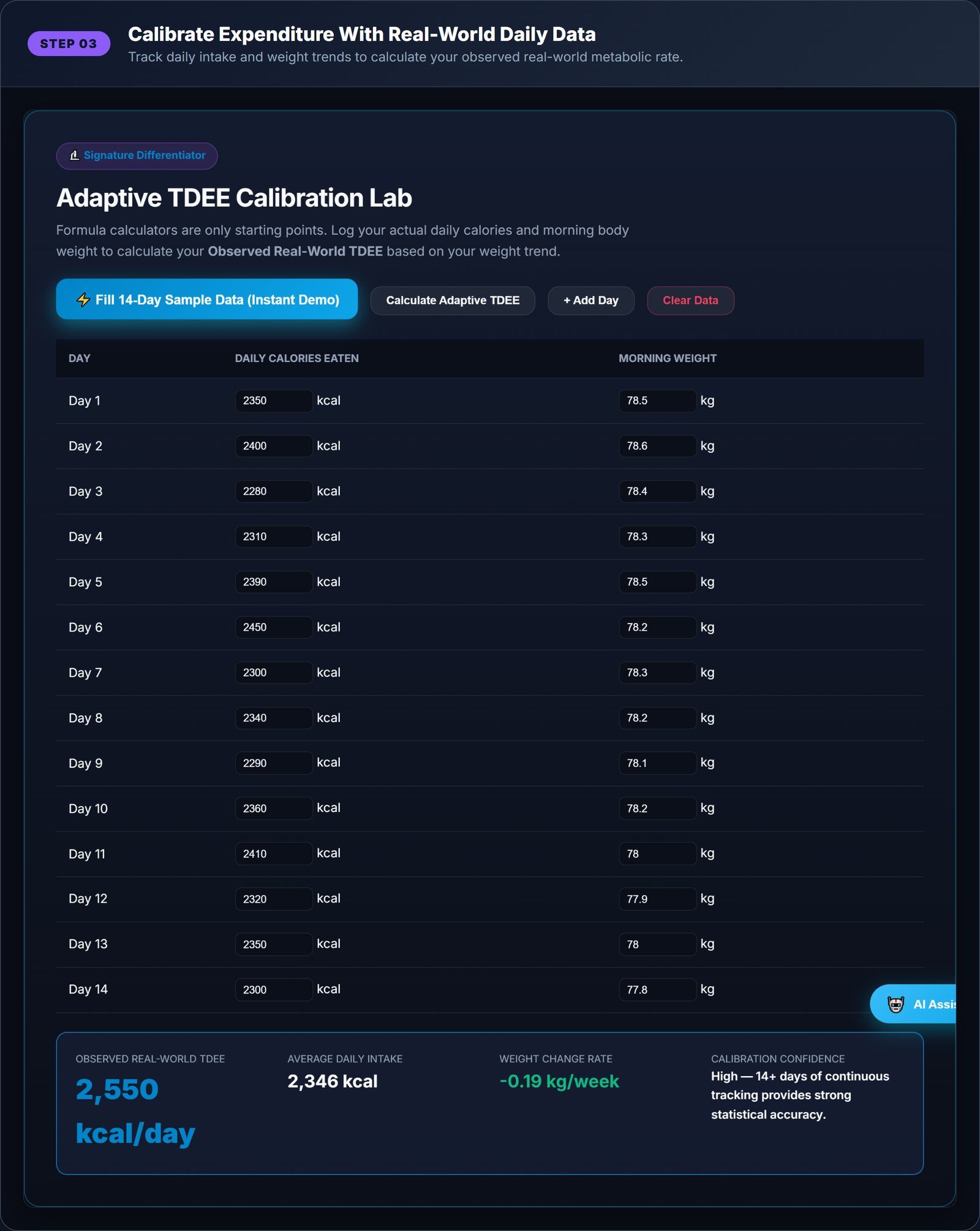
Adaptive TDEE Calibration Lab
Formula calculators are only starting points. Log your actual
daily calories and morning body weight to calculate your Observed Real-World TDEE based on
your weight trend.
Day
Daily Calories Eaten
Morning Weight
Click "Fill 14-Day Sample Data" above
to test adaptive expenditure calibration instantly!
Observed Real-World TDEE
2,545
kcal/day
Average Daily Intake
2,350 kcal
Weight Change Rate
-0.22
kg/week
Calibration Confidence
High (14
Days)
🩺 "Why Am I Not Losing Weight?" Diagnostic
Eating below your estimated TDEE but scale isn't
moving? Answer 6 quick questions to diagnose potential tracking errors, hidden calories, or water retention.
TDEE Calculator: Calculate Your Total Daily Energy Expenditure
You enter your age, weight, height, and activity level into a TDEE calculator and get a calorie number. But what does that number actually mean? If another calculator gives you a different result, it can be hard to know which number to trust. The problem is that a TDEE estimate is not a direct measurement of how many calories your body burns each day.
This calculator is designed to make the number easier to understand. It uses the Mifflin-St Jeor equation to estimate resting energy expenditure and an activity factor to estimate total daily energy expenditure. It also explains how the result is calculated, how to choose your activity level, why estimates can differ, and how to compare the estimate with your real-world results. The Mifflin-St Jeor equation was developed from measured resting energy expenditure in 498 healthy adults. (PubMed [1])
How to Use the TDEE Calculator: Step-by-Step Visual Guide
Follow this quick 3-step visual guide to calculate your daily energy expenditure, select your fitness target, and calibrate your observed real-world metabolic rate.
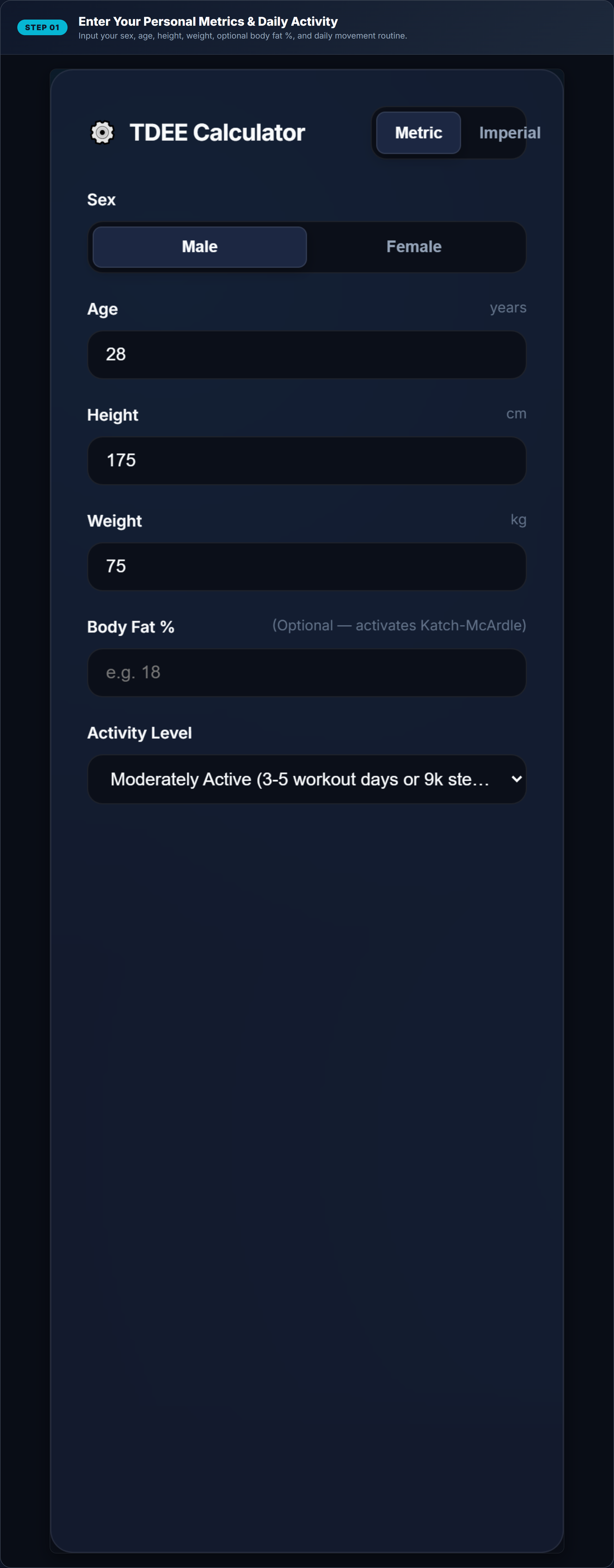
Step 1: Input Your Personal Metrics & Daily Activity — Select your biological sex, enter age, height, weight, and optional body fat percentage (activating Katch-McArdle formula). Choose the activity level that best matches your typical week or use our 60-second activity questionnaire.
Step 2: Review TDEE Calculation, Target Goals & Macro Split — Receive your estimated daily expenditure (kcal/day) with confidence range. Use the interactive Goal Target Simulator for weight maintenance, slow deficit, optimal deficit, aggressive deficit, or lean bulk, complete with customized protein, carbohydrate, and fat gram breakdowns.
Step 3: Calibrate Expenditure With Real-World Data — Formula calculators provide initial baseline estimates. Use our Adaptive TDEE Calibration Lab to log actual daily calorie intake and morning weight for 14 to 28 days to calculate your true observed metabolic rate.
What Is TDEE?
TDEE stands for Total Daily Energy Expenditure.
It is an estimate of the total energy, expressed in kilocalories (kcal), that your body expends over a 24-hour period to support baseline survival, daily movement, physical work, and food digestion.
Your daily energy expenditure includes energy used at rest, physical activity, and the thermic effect of food. Resting energy expenditure is generally the largest component for most people, accounting for 60% to 75% of total daily burn. (NCBI [2])
Your individual energy needs are affected by factors such as:
Age: Metabolic rate gradually declines with age, largely due to loss of muscle mass (sarcopenia) and hormonal shifts.
Body size: Larger bodies with greater mass require more energy to move and maintain cellular functions.
Body composition: Muscle tissue consumes roughly 13 kcal/kg daily at rest compared to fat's 4.5 kcal/kg.
Physical activity: Workouts, cardio, and sports elevate total energy expenditure above baseline.
Daily movement: Unplanned movement like walking, standing, and fidgeting significantly alters daily burn.
Food intake: Digesting, absorbing, and processing food requires metabolic energy.
Physiological factors: Thyroid hormones, body temperature regulation, and genetics impact metabolic rate.
This means two people with similar height and weight can still have different actual energy needs based on muscle mass and step counts.
A TDEE calculator uses an equation and activity assumptions to estimate your needs. It does not directly measure your metabolism.
Why Your TDEE Matters
Your estimated TDEE gives you a starting point for understanding your daily calorie needs.
If you want to maintain your weight, the estimate can help you choose a starting maintenance calorie target.
If you want to lose weight, it can help you understand how a calorie deficit relates to your estimated energy expenditure.
If you want to gain weight, it can help you plan around a calorie surplus.
The important part is how you use the number.
Your calculated TDEE should be treated as a starting estimate, not an exact measurement. Your body-weight trend and calorie intake over time can provide useful information about whether the estimate matches your actual needs.
The Three Components of Daily Energy Expenditure
Total daily energy expenditure has three main components.
Resting Energy Expenditure
Resting energy expenditure, or REE, is the energy your body uses to support normal functions while at rest.
This includes essential processes such as breathing, circulation, brain activity, liver function, and kidney filtration.
Internal organs account for most REE: liver (~27%), brain (~19%), skeletal muscle (~18%), kidneys (~10%), and heart (~7%). REE is usually the largest part of total daily energy expenditure. (NCBI [2])
Physical Activity
Physical activity increases your energy use above resting levels and is split into exercise and non-exercise movement.
Exercise energy expenditure includes planned workouts such as:
Walking for exercise
Running
Cycling
Strength training
Swimming
Sports
It also includes everyday movement (NEAT) such as walking around your home, working, shopping, and physical tasks.
Non-exercise activity can vary widely between people, which is one reason calorie needs are difficult to predict with a simple formula. (NCBI [3])
Thermic Effect of Food
Your body also uses energy to digest, absorb, and process food.
This is called the thermic effect of food, or TEF (roughly 10% of daily intake).
Protein has the highest thermic effect (20%–30%), carbs moderate (5%–10%), and fats lowest (0%–3%).
Together, resting energy expenditure, physical activity, and the thermic effect of food make up total daily energy expenditure. (NCBI [2])
How TDEE Is Calculated
A standard TDEE calculator usually uses two main steps.
Step 1: Estimate your resting energy expenditure.
Step 2: Apply an activity factor.
A common estimation method is:
Estimated TDEE = Estimated Resting Energy Expenditure × Activity Factor
Many consumer calculators call the first number BMR, or Basal Metabolic Rate.
Strictly speaking, BMR and REE are different measurements. BMR has more specific testing conditions, while REE is commonly used in practical prediction equations. In everyday calculator use, the terms are often treated as interchangeable because the difference is usually relatively small. (NCBI [4])
The Mifflin-St Jeor Equation
The Mifflin-St Jeor equation is a widely used predictive equation for estimating resting energy expenditure.
The original study was published in 1990 and developed the equation using data from 498 healthy adults measured with indirect calorimetry. (PubMed [1])
For Men
REE = (10 × weight in kg) + (6.25 × height in cm) − (5 × age) + 5
For Women
REE = (10 × weight in kg) + (6.25 × height in cm) − (5 × age) − 161
These equations produce an estimate.
They do not directly measure how much energy your body uses.
Research has found that Mifflin-St Jeor performs well among commonly used prediction equations, but no prediction equation is exact for every person or population.
Step 2: Apply Your Activity Factor
After estimating resting energy expenditure, the calculator applies an activity factor.
A commonly used set of factors is:
Activity Level
Factor
General Description
Sedentary
1.2
Mostly sitting with little structured exercise (<5,000 steps/day)
Lightly Active
1.375
Light exercise 1–3 days/week or regular light movement (5,000–8,000 steps)
Frequent hard exercise 6–7 days/week (11,000–15,000 steps)
Extra Active
1.9
Very high activity or demanding physical labor work (>15,000 steps)
These factors are practical estimation categories.
They are not laboratory measurements.
Your daily activity can fall between categories, so focus on your normal routine rather than your most active week.
How to Choose Your Activity Level
Choosing an activity level is one of the most difficult parts of using a TDEE calculator.
Do not look only at your workouts.
Think about your complete day.
Ask yourself:
How much do I walk?
Do I sit for most of the day?
How often do I exercise?
How hard are my workouts?
How long do my workouts last?
Is my job physically demanding?
How active am I outside the gym?
For example, someone who trains three times per week but sits at a desk for most of the day may have a different total activity level from someone who trains three times per week and also walks or works on their feet for several hours.
Use the activity level that best represents your normal week, not your best week.
Worked TDEE Example
Consider a 28-year-old woman who weighs 65 kg, is 165 cm tall, and is moderately active.
First, estimate resting energy expenditure:
REE = (10 × 65) + (6.25 × 165) − (5 × 28) − 161
REE = 650 + 1,031.25 − 140 − 161
REE = 1,380.25 calories/day
Now apply the moderate activity factor of 1.55:
TDEE = 1,380.25 × 1.55
TDEE ≈ 2,139 calories/day
Her estimated TDEE would therefore be about 2,140 calories per day.
This is an estimate based on the information entered. It should not be interpreted as a precise measurement of her actual daily energy expenditure.
How to Use Your TDEE for Weight Maintenance
If your goal is to maintain your current weight, your estimated TDEE can be used as a starting point for your daily calorie intake.
For example, if your estimated TDEE is 2,400 calories, you could use 2,400 calories as an initial maintenance estimate.
Then monitor your weight trend over time.
If your average weight stays relatively stable, your actual maintenance intake may be close to the estimate.
If your weight consistently changes, your actual maintenance needs may differ from the calculated value.
This is why maintenance calories are better viewed as a real-world outcome rather than a number guaranteed by a calculator.
How to Use Your TDEE for Weight Loss
Weight loss generally requires a sustained energy deficit.
A calorie deficit means that energy intake is lower than energy expenditure over time.
Your estimated TDEE can provide a starting point for understanding your maintenance needs and choosing a calorie target.
A person trying to lose weight may choose a calorie intake below that estimate.
The appropriate calorie target depends on the individual and should not be based on the assumption that a larger deficit is always better.
Monitor your progress over time instead of judging the result from a single day.
How to Use Your TDEE for Weight Gain
Weight gain generally requires a sustained energy surplus over time.
If your estimated TDEE is 2,400 calories, eating more than your maintenance needs (e.g. 2,650 calories) may create a calorie surplus for muscle building.
Your target should be appropriate for your goal and circumstances.
As your body weight and activity change, your estimated calorie needs can change as well.
Understanding Your TDEE Calculator Results
Your calculator may show several numbers.
Each one has a different purpose.
Estimated Resting Energy Expenditure
This is the estimated energy your body uses at rest.
Many consumer calculators label this value as BMR even when the underlying equation estimates REE.
TDEE
TDEE is your estimated total daily energy expenditure.
It accounts for your estimated resting energy needs and the activity factor selected in the calculator.
Maintenance Calories
Maintenance calories describe an intake level associated with maintaining body weight over time.
Your estimated TDEE can be used as a starting estimate for maintenance calories.
It is not a guarantee that eating exactly that number will keep your weight unchanged.
Macronutrients
Macronutrients are nutrients your body needs in relatively large amounts.
The three main macronutrients are:
Protein (4 kcal/g)
Carbohydrates (4 kcal/g)
Fat (9 kcal/g)
A TDEE calculator can use your calorie target as the starting point for estimating a macro plan.
Macro targets are also estimates and should be selected according to the person's goals and dietary needs.
TDEE vs BMR
TDEE and BMR are related but different.
BMR / REE
TDEE
Focuses on energy used at rest
Estimates total daily energy expenditure
Does not include your complete daily activity
Accounts for activity through the calculation method
Used as the starting point in many TDEE calculations
Used to estimate daily calorie needs
A simple way to remember the difference:
BMR/REE = estimated energy needed at rest
TDEE = estimated energy used across the day
For scientific precision, BMR and REE are not exactly the same measurement. Consumer calculators often use the terms interchangeably. (NCBI [4])
TDEE vs Maintenance Calories
These terms are closely related, but they are not identical.
TDEE is an estimate of energy expenditure.
Maintenance calories describe an intake level associated with maintaining body weight over time.
A TDEE calculator can therefore provide a starting estimate for maintenance calories.
Your actual maintenance intake is better judged by looking at your calorie intake and body-weight trend over time.
How Accurate Is a TDEE Calculator?
A TDEE calculator provides an estimate.
It does not directly measure your total daily energy expenditure.
Prediction equations can be useful, but individual results can differ from the predicted value.
Your actual energy needs can be affected by:
Body size
Body composition
Age
Physical activity
Non-exercise movement
Food intake
Physiological factors
Changes in body weight
The activity factor also introduces uncertainty because people with the same reported activity level can have different daily movement patterns.
For this reason, a calculator result should be treated as a starting estimate, not an exact calorie requirement.
Can TDEE Be Measured?
Yes, energy expenditure can be measured using scientific methods, but this is different from using an online calculator.
Resting energy expenditure can be measured using indirect calorimetry, which estimates energy expenditure from oxygen consumption and carbon dioxide production.
Total daily energy expenditure can also be studied using methods such as doubly labeled water.
An online TDEE calculator does not perform these measurements.
Instead, it estimates your energy needs from personal information, a prediction equation, and an activity assumption. (PubMed [5])
That difference is important.
A calculator estimates TDEE. It does not measure your actual TDEE.
Why Can Two TDEE Calculators Give Different Results?
You may enter the same information into two TDEE calculators and receive different results.
This can happen because calculators may use different:
Resting energy equations
Activity factors
Input assumptions
Body-composition methods
Calculation methods
Rounding rules
For example, one calculator may use Mifflin-St Jeor while another may use a different equation.
Some calculators also provide multiple formulas and advanced metrics. Current competitor calculators offer different combinations of formulas, activity tools, body-composition inputs, and macro calculations. (TDEE Calculator [6])
Different results do not automatically mean that one calculator is broken.
Before comparing numbers, check the method behind each calculation.
How to Check Your Estimated TDEE With Real-World Data
Your calculated TDEE is a starting estimate.
Your real-world results can help you understand how close that estimate is to your personal needs.
A practical process is:
Calculate your estimated TDEE.
Choose a reasonable calorie target.
Track your calorie intake consistently.
Weigh yourself under similar conditions.
Look at the trend over several weeks.
Compare your average intake with your weight trend.
Adjust your estimate when your results consistently differ from your goal.
Do not judge your maintenance calories from one day of data.
Body weight can change from water, food volume, sodium, glycogen, and other short-term factors.
A longer trend provides more useful information.
What If My TDEE Seems Too High or Too Low?
If your calculated TDEE does not seem to match your real-world results, check the assumptions before changing everything.
Possible reasons include:
Incorrect height or weight
Incorrect age
An activity level that is too high
An activity level that is too low
Different daily movement than expected
Individual differences in energy expenditure
Changes in body weight
Inconsistent calorie tracking
Start by checking your inputs.
Then compare the estimate with your longer-term weight trend.
A calculator is not necessarily wrong because its result differs from your actual experience. Prediction equations estimate population patterns and cannot capture every individual difference.
Why Does TDEE Change Over Time?
Your estimated energy needs can change as your body and routine change.
Factors that can affect your estimate include:
Changes in body weight
Changes in physical activity
Changes in daily movement
Changes in body composition
Changes in lifestyle or work routine
For example, after losing a significant amount of weight, your estimated energy needs may be different because your body size has changed.
You do not need to recalculate TDEE every day.
Recalculate when there has been a meaningful change in your body weight, activity, or routine.
Common TDEE Calculation Mistakes
Choosing an Activity Level Based Only on Exercise
Your total activity includes more than gym sessions.
Consider your daily movement and work routine too.
Choosing Your Most Active Week
Use your normal routine.
Do not select an activity level based on an unusually active week.
Treating TDEE as an Exact Number
TDEE calculators use prediction equations and assumptions.
The result is an estimate.
Using One Day of Weight Change
Daily weight can change for many reasons.
Use a longer trend instead.
Changing Several Variables at Once
If you change calories, exercise, activity level, and other habits at the same time, it becomes harder to understand what caused a change in your results.
Make changes carefully and monitor the trend.
Assuming a Larger Calorie Deficit Is Always Better
A larger deficit is not automatically a better approach.
Calorie targets should account for individual needs, goals, and circumstances.
How TDEE Relates to Macros
TDEE gives you an estimated calorie budget.
Macros divide calories among protein, carbohydrates, and fat.
For example, two diets can contain the same total calories while having different amounts of protein, carbohydrates, and fat.
Your TDEE therefore answers one question:
How much energy might I need each day?
A macro plan addresses another:
How might those calories be divided among macronutrients?
Macro targets are estimates too. They should be appropriate for your goals, dietary preferences, and individual needs.
Frequently Asked Questions
What does TDEE stand for?▼
TDEE stands for Total Daily Energy Expenditure. It is an estimate of the total energy your body uses during a 24-hour period.
What is a TDEE calculator?▼
A TDEE calculator estimates your daily energy expenditure using information such as age, sex, height, weight, and activity level.
How is TDEE calculated?▼
A common method estimates resting energy expenditure and then multiplies it by an activity factor.
Estimated TDEE = Estimated REE × Activity Factor
What formula does this TDEE calculator use?▼
The calculator uses the Mifflin-St Jeor equation to estimate resting energy expenditure and then applies an activity factor. The original Mifflin-St Jeor study was published in 1990. (PubMed [1])
Is Mifflin-St Jeor accurate?▼
Mifflin-St Jeor is a widely used predictive equation and has performed well compared with several older equations. However, it is still a prediction and cannot be exact for every individual.
Is TDEE the same as maintenance calories?▼
Not exactly.
TDEE is an estimate of energy expenditure. Maintenance calories describe an intake level associated with maintaining body weight over time.
TDEE can be used as a starting estimate for maintenance calories.
How accurate is a TDEE calculator?▼
A TDEE calculator provides an estimate rather than a direct measurement.
Your actual energy needs can differ because activity, body composition, daily movement, and other factors vary between people.
Why do two TDEE calculators give different results?▼
They may use different equations, activity factors, assumptions, or calculation methods.
Which activity level should I choose?▼
Choose the level that best represents your normal overall activity, including exercise, work, walking, and other daily movement.
Can I use TDEE for weight loss?▼
Yes. Your estimated TDEE can provide a starting point for understanding your maintenance calories and planning a calorie deficit.
Can I use TDEE for weight gain?▼
Yes. Your estimated TDEE can provide a starting point for planning a calorie surplus.
Does TDEE change when I lose weight?▼
It can. Changes in body weight and activity can change estimated energy needs.
Should I recalculate TDEE every day?▼
No. Daily recalculation is usually unnecessary. Recalculate when your body weight, activity, or routine changes meaningfully.
Can TDEE be measured?▼
Yes, energy expenditure can be measured using scientific methods such as indirect calorimetry and doubly labeled water. A normal online TDEE calculator estimates rather than measures your TDEE. (PubMed [5])
Should men and women calculate TDEE differently?▼
The Mifflin-St Jeor equation uses different constants for men and women, so sex is one of its inputs. (PubMed [1])
What if my calculated TDEE seems too high or too low?▼
Check your input information and activity level first. Then compare the estimate with your calorie intake and body-weight trend over several weeks.
Related Calculators and Guides
Use related tools and guides to understand different parts of your calorie and energy needs.
These pages should be connected with relevant internal links so users can move naturally from calculation → understanding → planning → related tools.
Disclaimer
This TDEE calculator provides an estimate for general informational and educational purposes.
It does not directly measure your metabolism or total daily energy expenditure.
Individual calorie and energy needs vary.
This calculator is intended for general adult use. It is not a substitute for individualized medical or nutrition advice.
If you are pregnant or breastfeeding, have a medical condition, have a history of an eating disorder, take medication that affects appetite or body weight, or have specific nutrition concerns, speak with an appropriate healthcare professional before making major changes to your diet or calorie intake.
About This Calculator
This calculator uses a transparent calculation method so you can understand where your estimate comes from.
The calculation uses the Mifflin-St Jeor equation to estimate resting energy expenditure and an activity factor to estimate total daily energy expenditure. The original Mifflin-St Jeor research measured resting energy expenditure using indirect calorimetry in 498 healthy adults. (PubMed [1])
The result is an estimate, not a laboratory measurement. The goal is to give you a useful starting point while making the calculation, assumptions, and limitations clear.
Important publishing note: For strong E-E-A-T, add a real author/reviewer name, credentials only if genuine, “last reviewed/updated” date, methodology/source links, and a clear About page. Don't add invented personal fitness or nutrition experience. The article itself now establishes expertise through transparent methodology, scientific sourcing, limitations, and practical interpretation rather than fabricated first-person claims. (PubMed [1])
🤖
Metabolic AI Assistant
Online · Evidence-based
🤖
👋 Hello! I am your Metabolic AI Assistant. Ask me anything about TDEE, BMR, fat loss deficits, macros, or share your age, height, and weight for an instant estimate!