TDEE for Muscle Building: How to Set Your Calories for Muscle Gain
TDEE is an estimate of the calories you use each day. For muscle building, it can serve as a starting maintenance baseline before you choose a calorie target and refine it using your real-world progress.
Core Concept:
TDEE is a starting estimate, not a permanent prescription. Use calculated TDEE as your maintenance baseline, add a calculated surplus, track your scale weight trends and lifting performance over 2–4 weeks, and adjust calories based on actual results.
Calculate Your Muscle Building Calories
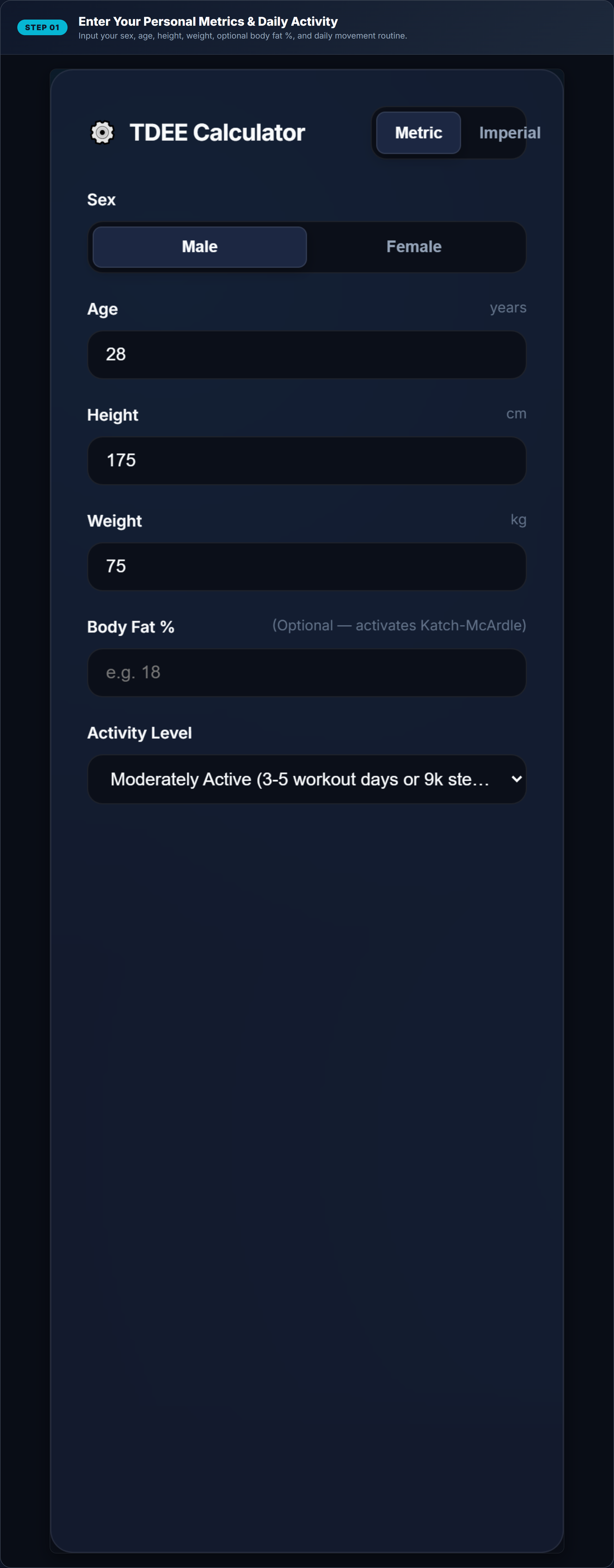
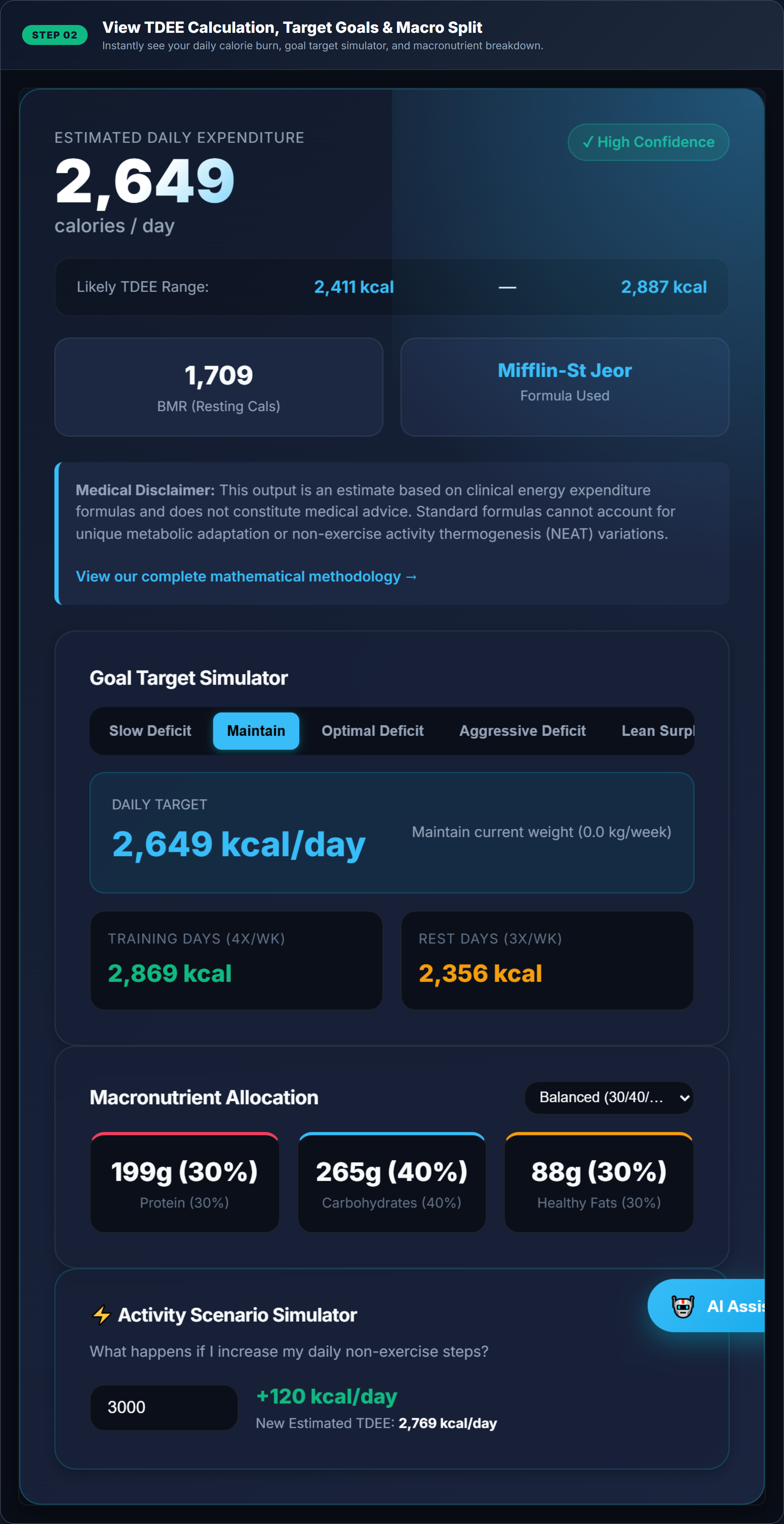
Use our interactive calculator to estimate your daily baseline expenditure and personalized surplus target.
Calculate Your TDEE →The Continuous Feedback Loop
How TDEE Helps You Build Muscle
What TDEE Actually Tells You
Your Total Daily Energy Expenditure (TDEE) is an estimate of the total daily energy your body expends to maintain basic biological functions and power physical movement. It combines your Basal Metabolic Rate (BMR), Thermic Effect of Food (TEF), Non-Exercise Activity Thermogenesis (NEAT), and Exercise Activity Thermogenesis (EAT).
Why TDEE Is Only a Starting Point
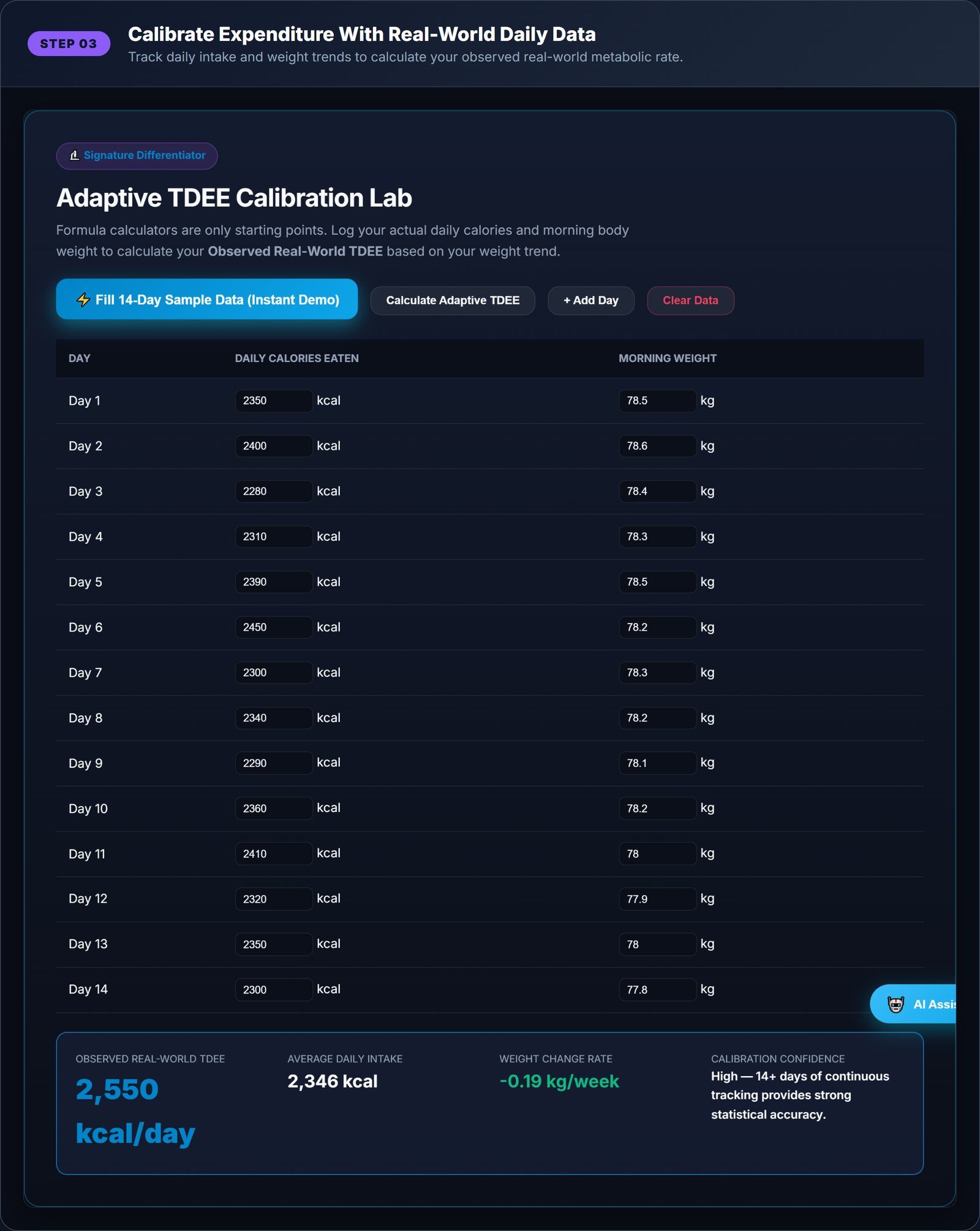
Mathematical formulas cannot capture daily shifts in fidgeting, digestive efficiency, stress, or sleep quality. For this reason, calculated TDEE represents a baseline estimate rather than an exact biological measurement. Treat your result as an initial hypothesis to test in the real world.
TDEE vs. Maintenance Calories vs. Muscle-Building Calories
Is TDEE the Same as Maintenance Calories?
Direct Answer: Conceptually, TDEE and maintenance calories refer to the same concept: the energy needed to keep body weight stable. However, calculated TDEE is a mathematical estimate, whereas your actual maintenance intake is determined by real-world weight trends over time.
Why Your Muscle-Building Calories May Be Higher Than TDEE
Synthesizing new muscle tissue requires energy. Consuming slightly more energy than your estimated maintenance baseline ensures your body has the substrate and anabolic signals necessary to recover from resistance training and build lean tissue.
How to Calculate Your TDEE for Muscle Building
Step 1: Estimate Your BMR
Basal Metabolic Rate represents energy burned at complete rest. Validated equations like Mifflin-St Jeor calculate BMR using your age, sex, height, and weight.
Step 2: Account for Physical Activity
Multiply your BMR by an activity factor ranging from 1.2 (sedentary) to 1.9 (extremely active) to account for daily job movement and structured lifting sessions.
Step 3: Estimate Your TDEE
Multiplying BMR by your activity factor yields your estimated TDEE. This represents your estimated daily energy expenditure.
Step 4: Use TDEE as Your Starting Point
Take this calculated baseline as your starting energy target before adding a calibrated surplus for hypertrophy.
How Many Calories Above TDEE Should You Eat?
Is a Calorie Surplus Necessary for Muscle Growth?
A calorie surplus is commonly used to maximize the rate of muscle growth. While muscle gain without a surplus is biologically possible under specific conditions (such as in training beginners), an energy surplus provides optimal conditions for hypertrophic adaptation.
Should You Use a Small, Moderate, or Large Surplus?
Research indicates that smaller to moderate surpluses are typically sufficient for maximizing muscle gain while limiting excess fat storage:
- Beginners: +300 to +400 kcal/day (higher potential rate of tissue growth).
- Intermediates: +200 to +300 kcal/day.
- Advanced Lifters: +150 to +200 kcal/day (lower rate of muscle growth potential).
Why More Calories Do Not Automatically Mean More Muscle
Muscle protein synthesis has biological speed limits. Consuming an excessively large surplus (+800 to +1,000 kcal/day) does not double muscle growth; instead, the extra energy is predominantly stored as body fat.
Example: Turning Your TDEE Into a Muscle-Building Calorie Target
Fictional Example Scenario:
- Lifter: Alex, 175 lbs, lifting 4 days/week.
- Estimated BMR: 1,700 kcal/day.
- Activity Factor: 1.425 (Moderately Active).
- Estimated TDEE (Maintenance Baseline): ~2,422 kcal/day.
- Chosen Surplus: +275 kcal/day (Moderate surplus).
- Starting Calorie Target: ~2,700 kcal/day.
Note: This scenario demonstrates the calculation process and is not a universal prescription.
What to Eat for Muscle Growth
Protein for Muscle Building
Protein provides essential amino acids required for muscle protein synthesis. Research suggests consuming approximately 1.6 to 2.2 grams of protein per kilogram of body weight (0.7 to 1.0 g/lb) per day support optimal hypertrophy.
Carbohydrates and Dietary Fat
Carbohydrates replenish muscle glycogen stores and fuel high-intensity lifting workouts. Dietary fats (20%–35% of total calories) support hormone production and cellular health. Learn more with our Macro Calculator.
Why Resistance Training Matters for Muscle Building
Progressive Resistance Training
Calories alone do not build muscle. Mechanical tension from progressive resistance training provides the essential biological signal that instructs your body to direct surplus calories into muscle tissue growth rather than fat storage.
Calories Cannot Replace Training
Eating in a calorie surplus without structured, progressive lifting will result in fat gain rather than muscular hypertrophy.
How to Track Whether Your Calorie Target Is Working
Track Body-Weight Trends
Weigh yourself 3–5 times per week under consistent conditions (e.g., morning after waking). Use weekly average trends rather than reacting to daily scale fluctuations caused by water weight and digestion.
Track Training Progress
Monitor your performance on primary compound lifts. Gradual increases in weight lifted or repetitions completed signal positive adaptation.
Consider Body Composition
Track waist measurements, progress photos, and how clothing fits to distinguish lean tissue gain from body fat accumulation.
When to Increase or Decrease Your Calories
If Your Weight Is Not Increasing
If scale averages remain flat after 3–4 weeks and lifting performance is stagnant, increase daily intake by 100–150 calories.
If Your Weight Is Increasing Quickly
If weight increases faster than 2–3 lbs per month (in intermediate lifters) alongside rapid waist growth, reduce daily intake by 100–150 calories.
If Your Weight Increases but Training Stalls
Review training quality, recovery, sleep, and protein distribution before automatically increasing intake further.
Progress Interpretation Framework
| What you're seeing | What to consider |
|---|---|
| Weight is relatively stable | Check whether intake is actually near the estimated maintenance level |
| Weight is gradually increasing | Monitor training progress and body composition |
| Weight is increasing rapidly | Review whether the calorie target is higher than necessary for your goal |
| Weight is not increasing | Check tracking accuracy, consistency, activity, and intake |
| Weight increases but training stalls | Review training quality, recovery, protein, and overall plan |
When Should You Recalculate Your TDEE?
After Meaningful Body-Weight Changes
Recalculate your baseline TDEE after gaining 5–10 lbs of body mass, as larger body mass increases baseline energy expenditure.
After Activity Changes
Recalculate if your daily occupational activity or exercise frequency changes significantly (e.g., taking a new job or adding extra training sessions).
When Real-World Results Do Not Match the Estimate
If actual weight trends consistently diverge from your initial target over a month-long evaluation period, update your calculations using your new baseline body weight.
Can You Build Muscle Without Eating Above TDEE?
Direct Answer: Yes, under specific physiological conditions known as body recomposition. Beginners, individuals returning from a layoff, or individuals carrying higher body fat can build muscle at maintenance calories or even in a mild energy deficit. However, experienced lifters with lower body fat typically require an energy surplus for sustained growth.
Lean Bulk vs. Aggressive Bulk
A lean bulk targets a modest calorie surplus (+200 to +300 kcal/day) for gradual weight gain, prioritizing lean muscle mass while minimizing fat gain. An aggressive bulk uses a large surplus (+500 to +1,000 kcal/day), which increases body weight faster but results in a significantly higher proportion of fat accumulation without increasing the rate of muscle growth.
Common TDEE and Muscle-Building Mistakes
- Mistake: Treating calculated TDEE as an exact number.
Why it matters: Causes frustration when real-world results differ from calculated numbers.
Better approach: Treat TDEE as a baseline starting estimate to be refined by real-world scale trends. - Mistake: Automatically adding a massive calorie surplus.
Why it matters: Leads to excessive fat gain without speeding up muscle growth.
Better approach: Use a modest, calibrated surplus suited to your experience level. - Mistake: Reacting to daily scale fluctuations.
Why it matters: Daily weight varies due to water, sodium, and digestion, causing unnecessary calorie changes.
Better approach: Track 7-day weekly averages over 2–4 week blocks. - Mistake: Ignoring resistance training progression.
Why it matters: Extra calories without progressive overload lead to fat gain.
Better approach: Ensure progressive overload in key lifts alongside your calorie surplus.
Frequently Asked Questions
Is TDEE the same as maintenance calories?
TDEE is a calculated mathematical estimate of daily energy expenditure, whereas maintenance calories represent the real-world daily calorie intake that keeps your weight stable over time.
How many calories above TDEE should I eat to build muscle?
For most lifters, a modest surplus of 200 to 400 calories per day above estimated TDEE is optimal for supporting muscle growth while minimizing excess fat gain.
Can I build muscle without a calorie surplus?
Yes. Training beginners, individuals returning after a break, or those with higher body fat can build muscle at maintenance calories through body recomposition. Intermediate and advanced lifters generally benefit from a dedicated surplus.
How often should I recalculate TDEE?
Recalculate TDEE after meaningful body-weight changes (5–10 lbs), major shifts in daily activity levels, or when real-world weight trends deviate from expected progress over a 3–4 week period.
What if I am not gaining weight above my TDEE?
If scale weight is stable over 3–4 weeks, your estimated TDEE may have underestimated your true maintenance intake. Increase daily intake by 100–150 calories and reassess after 2 weeks.
Does TDEE increase when you gain muscle?
Yes. Muscle tissue is metabolically active, slightly increasing your BMR. Furthermore, moving a heavier body during workouts and daily activity increases overall energy expenditure.
Is a bigger calorie surplus better for muscle growth?
No. Muscle protein synthesis has an upper physiological limit. Calorie surpluses beyond what is needed for maximal hypertrophy are stored primarily as body fat.
Calculate Your TDEE for Muscle Building
Ready to Set Your Starting Calorie Target?
Use our TDEE calculator to estimate your maintenance calories and select a starting surplus tailored to your experience level.
Scientific Evidence & References
Guidance in this article is supported by peer-reviewed sports nutrition and exercise physiology literature indexed in PubMed and NCBI.
- Slater GJ, et al. Is an Energy Surplus Required to Maximize Skeletal Muscle Hypertrophy in Resistance-Trained Individuals? Front Nutr. 2019. (NCBI [1])
- Morton RW, et al. A systematic review, meta-analysis and meta-regression of the effect of protein supplementation on resistance training-induced gains in muscle mass and strength in healthy adults. Br J Sports Med. 2018. (PubMed [2])
- Iraki J, et al. Nutrition Recommendations for Bodybuilding Contest Preparation: Exercise and Performance. J Int Soc Sports Nutr. 2019. (PubMed [3])
Educational Disclaimer
Disclaimer: This calculator and guide provide general educational information, not individualized medical or nutrition advice. Individual calorie and nutrition needs vary. If you have a medical condition, are pregnant, follow a prescribed diet, or have a history of an eating disorder, consult an appropriately qualified healthcare professional.